Sunday, 19 May 2013

Favourite pubs of Bristol, part one.


Last night I decided to take the long way home from work and visit a couple of pubs en-route. I drank some of the best beers I've had in ages (that weren't homebrew, of course!) and it inspired me to put some of my favourite Bristol pubs up here. Now, this is by no means an exhaustive list, but when I was deciding which places to go to for good beer on the way home, these were the places I chose.


First off is The Three Tuns in Hotwells. It's an Arbor Ales pub, so it's always got a good selection of Arbor brews, but it also sources some of the best craft brews from all over Britain. Last night I started, perhaps in a foolhardy fashion, with a half of the Double Citra IPA from The Kernel brewery. A truly stunning beer! I followed it up with another great beer from the Moor Beer Company, and a chat with Henry behind the bar. Turns out he's a homebrewer too - always a good sign!


The Hillgrove in Kingsdown is another favourite of mine. It's owned by the Dawkins brewery, so expect a few of their beers on tap. Thankfully, their beers have got much better since they took on a new head brewer, and they've started experimenting with a few more styles too. I had their ruby mild the other day and it was delicious. They also stock local bottled beers as well as having a few guest ales on pump. All the beers are listed on chalkboards with tasting notes too, so picking your poison is a little less pot-luck! The Hillgrove also has a lovely little courtyard garden out the back.


The Hare on the Hill (or on twitter here) has been a favourite pub for a while but, as a Bath Ales pub, they were only allowed to stock Bath Ales beers. As a result I found myself going there less often. I find their beers less to my taste now, though I used to like them a lot. Whether that's down to their beers getting worse or not is a much discussed topic in Bristol (my opinion is that Gem is not a patch on what it used to be). Nowadays, however, the landlord has been given a bit more freedom to stock some good guest beers too, so it was my absolute pleasure to order a Magic Rock High Wire the other day. A lovely pint it was too! It's clear that the landlord here knows his beer, as evidenced by the Kernel Table Beer in the fridge. So it was no surprise to find out he's a homebrewer too!

So, that's the first three pubs in my favourites list. It's great how the staff at these places are embracing twitter and facebook to get the punters involved, and to provide a up to date list of what beers they've got on. A pub should be proud of it's beers! To be continued...

Photos lifted from google images, will be replaced with my own when I remember to take some!

Wednesday, 8 May 2013

Saison time again

Summer has finally arrived in Bristol! Or is this just a late spring heatwave? It seems like so long since the sun came out I can't remember what season this weather is most representative of. But whatever the case, yesterday was hot so I brewed OUTSIDE! That's right, alfresco brewing has come to Bristol. Though it was only halfway through the brew day that I decided to move outside, so rather than being a relaxing day in the garden, there was a significant amount of scrabbling around for extension leads and general flapping about to get ready in time!

Ingredients

Amt
Name
Type
#
%/IBU
2.64 kg
Pilsner (2 Row) Ger (3.9 EBC)
Grain
1
58.3 %
0.88 kg
Maris Otter Low Colour Pale Malt (2.5 EBC)
Grain
2
19.4 %
0.76 kg
Wheat, Flaked (3.2 EBC)
Grain
3
16.7 %
0.25 kg
Corn, Flaked (2.6 EBC)
Grain
4
5.6 %

67.00 g

Hallertauer (2012) [2.80 %] - Boil 60.0 min

Hop

5

24.4 IBUs
1.00 tsp
Irish Moss (Boil 15.0 mins)
Fining
6
-
25.00 g
Saaz [4.15 %] - Boil 15.0 min
Hop
7
3.6 IBUs
33.00 g
Saaz [4.15 %] - Boil 2.0 min
Hop
8
3.0 IBUs
46.00 g
Saaz (2012) [3.10 %] - Aroma Steep 0.0 min
Hop
9
0.0 IBUs
8.00 g
Saaz [4.15 %] - Aroma Steep 0.0 min
Hop
10
0.0 IBUs

1.0 pkg

French Saison (Wyeast Labs #3711) [50.28 ml]

Yeast

11

-


So, it's another saison using the 3711 yeast but this one has no sugar addition. The two recipes I've made so far both had sugar additions, and I'm not sure whether I like this. There's a slightly sharp, cidery taste in the beer that I think might come from the sugar. I've heard from another source that the 3711 doesn't perform too well with sugar additions, so I looked around for a recipe without one. Happily I found this recipe on the mad fermentationist's blog here. It's his Lomaland saison recipe and so I have high hopes! Plus, the flaked corn is not something I've used before, so following this recipe I should be able to put together a recipe of my own that I'm happy with.

Alfresco boiling!

Brew day went smoothly but boiling outside may have resulted in greater boil off, as the final volume was down one litre on expected to 22L. Actually, this may also be down to the amount of hop material in the boiler. I used a total 179g of hops, so this probably absorbed quite a bit of wort. Minor panic with hops again as I didn't have the correct alfa acid percentages in beersmith. Had to re-jig the amounts to take account of this, but worked it all out in time.

The only other problem was that one of the extension leads I was using tripped out. I hadn't unwound it fully and I think it overheated or something. Switched to the other element for the rest of the boil, but don't think the extension lead has recovered. Might be time to get a new one!

Post boil, the wort went into the fermenter with O.G. 1.046, which is only one point above expected.

And if you're interested in such things as water treatment:
Lactic Acid: 9ml to mash to bring pH down to 5.46.
Gypsum: 4g to mash water, 4g to sparge water.
Epsom salts: 2g to mash water, 2g to sparge water.
Water left out overnight for chlorine to evaporate. Campden tablet added to drive off any chloramine.

Monday, 29 April 2013

Saison #1

A while back I decided I would have a bash at making a saison. I can't say I've got a great deal of knowledge on the style, but I've liked the ones I've tried. Not having much of a background to draw on, I found a recipe online and decided to use that.

The recipe can be found here on the wiki for the American Homebrewers Association. It very helpfully pulls together all the prize-winning recipes from their national homebrew competition. It's a great resource because they are proven recipes and so logically, if you don't get great beer it's you, not the recipe! 

However, I decided to use a different yeast, and I altered some of the quantities, which you might say defeats the object! But anyway, here's the recipe I ended up brewing:


Ingredients

Amt
Name
Type
#
%/IBU
3.40 kg
Pilsner (2 Row) Ger (3.9 EBC)
Grain
1
70.8 %
1.15 kg
Munich Malt - 10L (19.7 EBC)
Grain
2
24.0 %
30.00 g
Bobek 2011 [5.17 %] - Boil 60.0 min
Hop
3
20.2 IBUs
1.00 tsp
Irish Moss (Boil 15.0 mins)
Fining
4
-
15.00 g
Bobek 2011 [5.17 %] - Boil 15.0 min
Hop
5
2.7 IBUs
4.00 g
Ginger Root (Boil 5.0 mins)
Herb
6
-
15.00
Peppercorns (Boil 5.0 mins)
Spice
7
-
1.00 tbsp
Coriander Seed (Boil 5.0 mins)
Spice
8
-
Red Grapefruit peel (Boil 5.0 mins)
Spice
9
-
20.00 g
Willamette [6.30 %] - Aroma Steep 0.0 min
Hop
10
0.0 IBUs

1.0 pkg

French Saison (Wyeast Labs #3711) [50.28 ml]

Yeast

11
-

0.25 kg

Sugar, Table (Sucrose) (2.0 EBC)

Sugar

12

5.2 %


I wanted to use Wyeast 3711 for another couple of saison recipes I had, so I decided to use it here as well, rather than WLP565. I wanted something a bit fresher and fruitier. I added the sugar in after four days, when the ferment had passed it's peak.

I was initially quite disappointed by how this turned out. There was some yeast character to it, but there was a dry aftertaste and a bit of sharpness to it. The yeast also fermented it down to 1.004, so it's dry as hell, which might account for some of the sharpness. The body is better than you would expect for a beer with such a low S.G. I didn't really get much character from the spices and fruit I put in.

On balance, I think I would be better trying this recipe with the WLP565 strain, as I think it would work better with the flavours. There is a slight cidery-ness to the beer that I think is coming from the sugar addition. I would try this recipe again with that yeast though.

I'm going to leave the beer to condition for a couple of months before I write off this experiment, though, as I have noticed an improvement over the few weeks that it's been bottled. It'll be interesting to see how it ages.

Oatmeal Stout

My first foray into stout country with an oatmeal stout. I'm not a great connoisseur of stouts, but I really like the idea of an oatey stout which is a bit fruity too. I'm using the second generation of the guinness yeast (WLP004) that I first used in the Irish red I made a couple of weeks ago. Hopefully the yeast will give it the fruity character I'm looking for. So anyway, here's the recipe:


Ingredients

Amt
Name
Type
#
4.64 kg
Maris Otter Low Colour Pale Malt (2.5 EBC)
Grain
1
72.6 %
0.51 kg
Oats, Flaked (Toasted) (2.0 EBC)
Grain
2
8.0 %
0.39 kg
Biscuit Malt (45.3 EBC)
Grain
3
6.0 %
0.26 kg
Crystal 145 EBC (5.9 EBC)
Grain
4
4.1 %
0.20 kg
Black Barley (Stout) (985.0 EBC)
Grain
5
3.1 %
0.20 kg
Chocolate Malt (886.5 EBC)
Grain
6
3.1 %
0.20 kg
Chocolate Malt (Pale) (525.0 EBC)
Grain
7
3.1 %
3.00 g
Liquorice (Boil 60.0 mins)
Flavor
8
-

50.00 g

EKG 2011 [5.40 %] - Boil 60.0 min

Hop

9

33.1 IBUs
1.00 tsp
Irish Moss (Boil 15.0 mins)
Fining
10
-
1.00 tsp
Yeast Nutrient (Boil 0.0 mins)
Other
11
-


The recipe is based on one I found in the wiki for the American Homebrewers Association here. One particular change I made though, was to use toasted oats. I really want to bring out the oat flavour, not just use them to add body, so I decided to toast the oats before adding them.


Oats under the grill (that's steam, not smoke!)
The first time I tried this I put them in the oven, but after a good 20 minutes they were still wanting a little more colour, so I turned up the oven. 10 minutes later and I opened the oven to a huge cloud of steam! The colour of the oats was good, but the steam mixed with oil in the oven and gave the oats an oily taste. Maybe time to clean the oven! Not time for that now though (when is it ever?) so I picked up some more oats and stuck them under the grill this time. I spread them quite thinly in the tray, so it took three batches, but it was much quicker and easier to keep an eye on them too.


Finely toasted oats.
As usual I cold steeped the dark grains overnight instead of adding them to the mash. I use Gordon Strong's suggested ratio of 1.9 litres of water to 454g of grain (it's simpler in imperial measurements). I've always had good results doing this. It avoids any harsh bitterness and gives a really smooth flavour. That's what I look for in a dark beer, so I've gone with it again here.


Having cold steeped the grains overnight, I use a colander to drain the grain bag.
In Gordon Strong's excellent book " Brewing better beer" (which I can highly recommend), he suggests that you can add the dark grain 'tea' directly to the fermenter. I don't feel right doing this as the grains haven't been sanitised at all and I can't believe that it wouldn't be a source of contamination. So I add the 'tea' to the boiler with 15 minuted to go. My thinking is that'll be enough time to kill off any nasties that might be lurking in there, but won't undermine the smoothness of the dark flavours.

Adding the dark grain 'tea' to the boiler.
The brew-day itself went pretty smoothly. There was a bit of an issue with the mash sticking, probably due to all the oats. But other than that it all went swimmingly! I hit my numbers with a post boil O.G. 1.060. So I'll look forward to trying this in a few weeks time, but I imagine it'll really come into it's own around the month mark.


Wednesday, 24 April 2013

Irish Red

My latest brew was an Irish Red - no, I don't really know what one of those is either. Inspired by an episode of the Jamil Show I decided to brew one to Jamil's recipe and see how it came out. From what I understand it will be pretty close to an English bitter, which is good because I've been meaning to brew one of those too! Lately I've been trying to get more methodical in planning my brew-days and be a bit more disciplined with what I brew when. I've been trying to re-use yeast to save some money, but also to take advantage of the better yeast flavour from successive generations. So, no more buying a new yeast for each brew and jumping from style to style. Well, less of that anyway.

So this recipe will be the first brew using WLP004 Irish ale yeast. Following this brew I intend to make a couple of stouts - probably an oatmeal followed by a coffee stout. I've not properly decided yet, but I reckon this is a good yeast to try them with - it's supposed to be the Guinness strain. All of the brews I'm doing at have half an eye on the National Homebrew Competition in the summer. If any of these turn out well, they could be my entries. Anyway, here's the recipe:

Ingredients

Amt
Name
Type
#
%/IBU
5.10 kg
Maris Otter Low Colour Pale Malt (2.5 EBC)
Grain
1
92.1 %
0.17 kg
Caramel/Crystal Malt - 40L (78.8 EBC)
Grain
2
3.1 %
0.17 kg
Crystal Malt 120 (240.0 EBC)
Grain
3
3.1 %
0.10 kg
Black Barley (Stout) (985.0 EBC)
Grain
4
1.8 %
35.00 g
EKG 2011 [5.40 %] - Boil 60.0 min
Hop
5
24.6 IBUs
1.00 tsp
Irish Moss (Boil 15.0 mins)
Fining
6
-
1.0 pkg

Irish Ale Yeast (White Labs #WLP004)

Yeast

7

-


It's a pretty simple recipe, and the brew-day went pretty smoothly. The only issue I had was with the grain bill. From looking through the grain list in Beersmith I can see there's a much lighter roasted barley, around 500 EBC. However, I can't find this grain for sale anywhere so I've had to use the darker black barley. I think the lighter grain would give the red colour without so much roastiness, so I reduced the amount of black barley to allow for this. It probably won't turn out exactly as it is designed to, but it's as close as I can get it.

After the boil the O.G. was 1.052, so bang on what I wanted. I pitched a 1.5 litre starter of yeast (just the slurry) and off it went. I kept the fermenter at 20C using the water bath, so it's possible it crept over that as the yeast really got going, but generally that's where it was. According to the style guidelines, this should finish no lower than 1.010, and waddya know - 1.013 after 11 days!
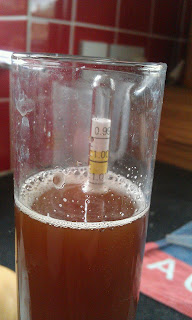
A pretty muddy looking beer at the moment, but that'll settle out... right?

Today I filled 40 bottles with this and had a bit left over, but no more bottles. Have to hope it's good now! The tastings I've had from the times I've tested the S.G. have all been promising. Good body, interesting malty character, with roasty overtones too. I thought it tasted a little sharp today too, but that's the only time I've tasted it, so I might've been mistaken. The malt flavours should blend more as it conditions in the bottle and work together quite well. I'm looking forward to tasting it when it's ready!

One learning point from the bottling session today, is to always bottle cold. I had the beer sat at 20C right up until I bottled it and as a result, got loads of CO2 bubbles in the tube when bottling. What I should've done is switch off the heater a day earlier, then let it cool overnight. This would also probably help with the clarity of the beer - not long term, but today the beer looked pretty muddy. A day or so in the cold would've helped drop the yeast out of suspension.

Wednesday, 17 April 2013

American IPA #3

I think one of the most important abilities that any brewer needs to have is repeatability. If I brew something once and it turns out well, I need to be able to know that I can brew it again, exactly the same. Likewise, if I want to change an element of a recipe, I need to know that all other parts can be kept constant so I can compare and assess the changes I made.

With this in mind I decided to rebrew my american IPA. The last time I brewed this I overshot the O.G. so it didn't turn out perfect, but it was still a good beer. So I knew there was room for improvement, but I also had a previous batch to compare it against.

The main difference was going to be a different yeast. I decided to re-pitch the yeast from the American Amber (Wyeast 1332) to save money, but also to compare the effect of the different yeast. As this was still an american strain I expected it to have a similar neutrality, but with a little extra yeast character to WLP001.

I collected the yeast from the bottom of the fermenter after bottling, put it in a sterilised jar, and set it in the fridge to settle out. Having read a few accounts of how to do this and watched a couple of youtube videos, I was expecting to see a layer of trub at the bottom. This never really appeared, so I imagine that I ended up pitching some trub with the yeast. I used Mr Malty's yeast pitching rate calculator to decide what volume of yeast to pitch (plus a little bit extra to allow for the trub).

Unfortunately, my experiment in repeatability fell at the first hurdle, when I went to weigh out the grain and found I didn't have what I needed - AGAIN! Not only was I missing the right crystal malts but I was 3kg short on base malt. 3kg! Sometimes I amaze myself! So what began as a straightforward experiment ended with a sharp trip to the homebrew shop for malt, and a swift re-jig of the recipe. This is what I ended up with:

Ingredients

Amt
Name
Type
#
%/IBU
5.50 kg
Lower Colour Pale Malt, Maris Otter (3.0 EBC)
Grain
1
85.9 %
0.35 kg
Caramel/Crystal Malt - 60L (118.2 EBC)
Grain
2
5.5 %
0.20 kg
Munich Malt (15.0 EBC)
Grain
3
3.1 %
0.15 kg
Caramel/Crystal Malt - 30L (59.1 EBC)
Grain
4
2.4 %
0.10 kg
Aromatic Malt (51.2 EBC)
Grain
5
1.6 %
0.10 kg
Wheat Malt, Bel (3.9 EBC)
Grain
6
1.6 %

20.00 g

Chinook [13.00 %] - Boil 60.0 min

Hop

7

35.3 IBUs
32.00 g
Cascade 2012 [7.50 %] - Boil 30.0 min
Hop
8
15.1 IBUs
16.00 g
Centennial 2012(2) [10.30 %] - Boil 30.0 min
Hop
9
10.4 IBUs
20.00 g
Cascade 2012 [7.50 %] - Boil 15.0 min
Hop
10
4.9 IBUs
10.00 g
Centennial 2012(2) [10.30 %] - Boil 15.0 min
Hop
11
3.4 IBUs
30.00 g
Cascade 2012 [7.50 %] - Aroma Steep 0.0 min
Hop
12
0.0 IBUs
15.00 g
Centennial 2012(2) [10.30 %] - Aroma Steep 0.0 min
Hop
13
0.0 IBUs


32.00 g
Cascade 2012 [7.50 %] - Dry Hop 7.0 Days
Hop
15
0.0 IBUs
15.00 g
Centennial 2012(2) [10.30 %] - Dry Hop 7.0 Days
Hop
16
0.0 IBUs


Bit of a pancake day grist (whatever's in the cupboard), but it might turn out to be a more interesting malt character behind the very prominant hops. Time will tell.

On the upside, the brew itself went pretty well and I pretty much hit my numbers. At least that's a positive to take away for the day!
Related Posts Plugin for WordPress, Blogger...