Showing posts with label Homebrew. Show all posts

Wednesday, 23 July 2014

Tafelbier - Low Gravity Brewing

If you follow anything related to homebrewing you will quickly realise that there is definite tendency for homebrewers to brew high ABV beers. Big beers create big impressions and when you want your beers to get noticed, this is often the easiest way to do it - particularly in competition. However, I think brewing big is also a way for mediocre brewers to disguise flaws in their beers and can quite often be a marker for lazy, unadventurous recipe formulation. Who cares about the correct yeast pitching rate, or eliminating off flavours, when you mask it with a couple of dry hop additions?! Sure it might be enjoyable to drink, but are you actually becoming a better brewer?

So as a bit of fun recently, one of the homebrew clubs I'm a member of (Bristol Craft Brewers) lay down a challenge to everyone to brew a low gravity beer for the August meeting. Quite a few people weren't all that interested in taking part, which is fair enough. Another problem with homebrewing is finding the time to do it and brewing an extra low abv beer just doesn't fit in with a lot of peoples' schedules, but hopefully there will be a few examples to try out.

The thing that I find so appealing about brewing a low abv beer is that it's a real challenge to get right. There's going to be a small grain bill so every bit counts. You also need to find a way of increasing the body so it doesn't taste watery. Hop bitterness will be overpowering in a light beer, so you can't just throw hops at it as you might a high gravity IPA. There is also the appealing factor that pretty much any colour/style of beer has the potential to be made into a low abv version. There are so many ways of building body in a beer - higher mash temperature, dextrin malts, crystal malts, yeast choice and so on - that you can choose whichever way suits the style best.

For my effort I took inspiration from a Belgian Tafelbier that was brewed to replace fizzy drinks in school! Yes, those crazy Belgians gave beer to school kids as a response to child obesity. So this is a very light beer brewed with some belgian yeast character, aiming to be refreshing and easy to drink (without getting drunk). Due to time constraints I only had a limited window to brew this between festivals this summer, and I was unable to order in any specific ingredients. This meant the only yeast I could get hold of was Safale T-58, a dry yeast that I haven't used before, and the specialty grains were led by what I already had. Having said that, I was happy with the recipe that I put together, I would've liked to have got hold of a more expressive and less attenuative yeast.


Ingredients

Amt
Name
%/IBU
1.700 kg
Pilsner (2 Row) UK (7.0 EBC)
73.3 %
0.250 kg
Vienna Malt (7.0 EBC)
10.8 %
0.150 kg
Caramunich I (Weyermann) (100.5 EBC)
6.5 %
0.120 kg
Aromatic Malt (51.2 EBC)
5.2 %
0.100 kg
Cara-Pils/Dextrine (3.9 EBC)
4.3 %

5.00 g

Magnum [14.20 %] - Boil 60.0 min

9.3 IBUs
0.50 tsp
Irish Moss (Boil 10.0 mins)
-
3.00 g
Peppercorns (Boil 5.0 mins)
-
1.0 pkg
SafBrew T-58
-

Brew Day - 20/07/2014
O.G. 1.027

I mashed at 69C to increase the amount of unfermentable sugars in the wort for extra body. The first gallon of runnings was boiled for an hour to reduce it to just over half of it's previous volume. This was intended to increase the caramel impression of the beer. The gravity numbers were a little higher than predicted, but I decided not to adjust it as the abv will be so low anyway.

Unfortunately, brewing on one of the hottest days of the year means that an immersion chiller isn't all that effective. The temp dropped quite well initially, but then stayed at around 23C. A check of the mains water temperature (20C) made up my mind that it wasn't going to drop too much more like that, so I ran it off into the fermenter and put that in my new brew fridge! I've set that for 17C, so hopefully it will be able to bring the wort down to a more realistic pitching temperature for the yeast.

The fridge took a few hours but got the wort down to a pitchable temperature of 17.9C by the end of the day. I was a bit concerned that the rehydrated yeast would've been at around 22C (ambient temp) when I pitched it, but there was not a lot I could do about that!

Sunday, 27 October 2013

First Foray with Rye - First FoRye?


There is a definite trend in my brewing decisions that goes along the lines of: I decide what to brew, buy all the ingredients, listen to a podcast/read an article about a different beer, get all enthusiastic about that, change all my plans! So staying true to this my plans to brew a big, possible double, IPA changed at the last minute to a pale ale with a high percentage of Rye.


I've never brewed with rye before, but from what I understand it brings quite an interesting peppery flavour to a beer. It seems like a grain that I should really know a bit more about and could be quite useful in future recipes. This new found interest came about after listening to another episode of Basic Brewing Radio. If you haven't listened to this podcast before I can highly recommend it. James Spencer has a really positive and approachable attitude to brewing, which makes the show entertaining whilst also being packed full of explorations in to the more technical aspects of brewing. I also really enjoy his interviews with local brewers which give some real insight into their approaches to brewing and their experiences home brewing too. James also has a website that runs as a companion to the podcast called Beer and Wine Journal. It updates every week (would that we could all be so reliable) and is required reading for me.

The episode that inspired me here, was about James' attempt to brew a 100% Rye Beer. Rye is apparently very gelatinous and gloopy when mashed, and mashing a high percentage of it in a beer ofter leads to a stuck mash. To get round this, James used the brew-in-a-bag method to avoid lauter issues. Instead of running the wort out through the rye, he lifted the rye out of the wort - cunning! The resultant session beer (another first for me) seems to have been pretty successful, so I decided to give something similar a go.

Now, I'm not really set up for brewing in a bag, and I'm not sure how successful a smaller batch would be in my electric boiler. So I decided to scale the recipe up to five gallons. But I did take on board the inherent problems with Rye, so I made a 50% Rye recipe with 50% Low Colour Maris Otter and threw in a bunch of Oat Husks too, just to make sure I got a good lauter. I had some Citra pellets in the freezer from our last brew-club bulk buy, so I kept faith with James' recipe with them.


Ingredients

Amt
Name
Type
#
%/IBU
1.50 kg
Maris Otter Low Colour Pale Malt (2.5 EBC)
Grain
1
50.0 %
1.50 kg
Rye Malt (5.0 EBC)
Grain
2
50.0 %
300.00 g
Oat Husks (Mash 60.0 mins)
Other
3
-
26.00 g
Citra [12.50 %] - Boil 60.0 min
Hop
4
46.5 IBUs
30.00 g
Citra [12.50 %] - Boil 5.0 min
Hop
5
8.9 IBUs
1.0 pkg
California Ale (White Labs #WLP001) [35.49 ml]
Yeast
6
-


The first problem I encountered was that Rye malt wasn't in Beersmith's list of ingredients, so a quick search was required to find the values for yield etc. Everything else was nice and simple - using only one hop and two grains is great! I really like the simplicity of the recipe, it really suits my aim of getting to know what the Rye contributes.

The night before brew day I set out my brewing water and treated it with some gypsum to help with hop character and some lactic acid to bring down the mash pH. I then added a campden tablet to drive off any chloramines in the water and went out to meet a friend for her birthday.
 
Such a small mash!
 Brew day itself began at 1:30pm with a stonking hangover! Birthday celebrations had gone on till the early hours and all intentions of an early start had fallen by the wayside. So the brewer's friend came into play, the split brew day! Quite early on I decided that I'd leave the mash for the following day, this was not going to be a quick efficient brew as it was, without it going on late.

So, with a little trepidation I mashed in the malt and set the day in motion. I decided to mash with 10 litres of liquor so it wasn't too dilute, but had enough liquid to avoid it gumming up too much. I also decided to fly sparge this one. The thinking here was again to avoid a stuck mash. I thought that if I batch sparged there was a danger that it would all stick together as it drained. So I hooked up the only spare tubing I had for the fly sparge, unfortunately this was a bit too long for my original idea of sprinkling the sparge water. So instead I looped the hose on top of the grain bed and ran the water in slowly. This actually seemed to work quite well and didn't stir up the mash bed.

New sparging technique is not easy to photograph but seemed quite effective.
 
Look, no hands! Fly-sparge in progress.

The pre-boil gravity on this was predicted as 1.022, so you can imagine my surprise when it came out at 1.030! The mash efficiency was 93%, which on my system is unheard of! I can only assume that the yield figures for Rye malt are a bit low, so the prediction was out to begin with. Anyway, wort smelled amazing and it was still on for a sub-3% beer, which was what I was going for, so I wasn't too worried. This was now 7pm, so I decided it was time to pack up, seal the wort up, and crack on with the boil the next day.

The hot break was pretty dense from all the rye and it just kept coming!

The following day I had to work, but as soon as I got home I got the boiler on and got cracking with finishing off the brew 'day'. The boil went well and the citra hops just smelled incredible! I was totally knocked out with how good they smelled, I had to stop myself from eating them! Because of this I upped the 5min addition from 26g to 30g. I was going to go further but I didn't want to over-power the rye. I can do the hop bomb another time.

Citra - well fruity!


The temperature here is still unseasonably warm, so chilling the wort was a bit of an issue. Getting the last of the heat out of it just takes ages and it was already getting late, so I decided on a further split in the brew day. I got the temp down to 26C, ran it off into the fermenter, sealed it up and went to bed! Overnight it dropped the last few degrees down to 20C, so I got up early and switched on the aquarium pump for an hour's aeration and pitched the yeast before leaving for work.

Chiller in the wort, conical flask sterilising on the hob.
 Despite a somewhat haphazard brew schedule I'm pretty pleased with the way the beer's progressing and I can't wait to try the finished pint!

Sunday, 15 September 2013

The National.

Well, that was a lot of fun!

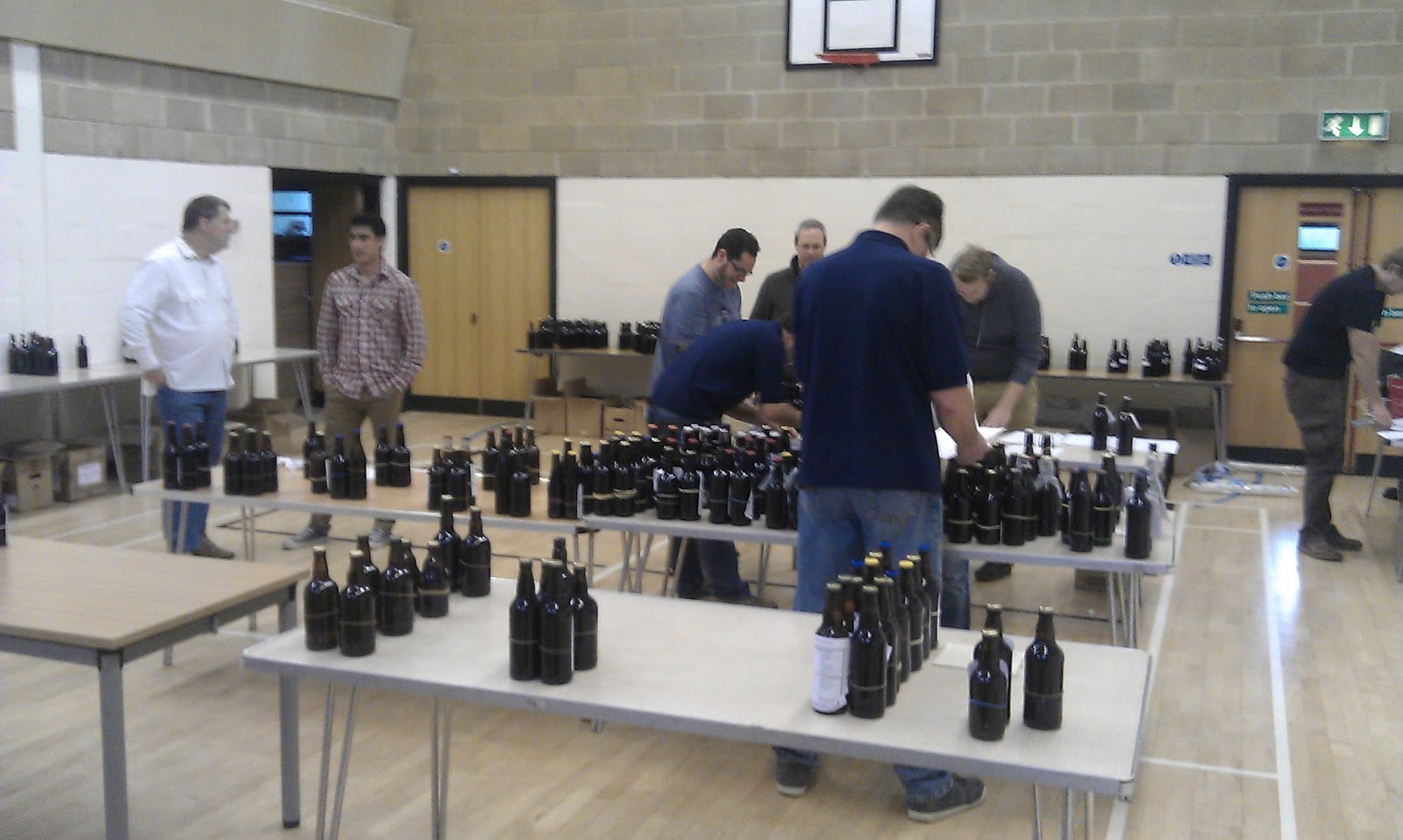
This weekend was the National Homebrew Competition in Oxford, the annual contest to find the best homebrews and brewers in the UK. It's all run by volunteers so I went along to help with the judging.

Setting up and organising the categories.

 The day started with a rather early 5:45 alarm! And on a Saturday! But against all probability I got up, showered and got to the train station in time to catch the 7am train to Oxford - thanks in no small part to my girlfriend driving me to the station. Meeting several other dazed Bristol homebrewers on the platform, we boarded the train clutching coffees and headed off.

All the essentials for beer judging.
My first category to judge was British Pale Ales, and while this wasn't the smallest category, it was a much easier start to the day than the poor table with Belgian Strongs. +9% beers at 10am are a test for sure! My category was a mixed bag, with no beers that I felt really stood out as great examples of the style. Quite dissapointing really, but there were a few good ones. I think the problem is that, for competition, brewers tend to focus on the more bombastic styles to create the biggest impact. It's difficult for any Pale Ale to compete with a Double IPA. So I think a lot of the better brewers stayed away from the category.

After lunch I judged the Smoked and Wood Aged category, which was really interesting. A wide range of different styles and some really cracking beers. Though, admittedly, some that were not good! A very good Smoked Imperial Stout, which poured like engine oil, took the category deservedly. It went on to be given second place in best of show.

Getting towards the end of judging now.
I finished off the afternoon judging Hybrid Beers, one of the more boring categories of beer in my opinion! To be fair, some of the beers we judged fitted the style guidelines closely and had been brewed with skill. I just find those styles dull. But following the strong stouts and porters of the earlier round, it was probably good to finish with quite light beers. This was also made more enjoyable because I was judging with a guy I know, Johnny, who brews for a living at Bristol Beer Factory.

So with all the judging finished, it was time for the awards to be given out and I only went a won a medal!!!

YEEEAAAHH!!!!
My Alfresco Saison took second place in the Belgian and French Ales category (Table 12 here). To say I'm happy about this would be understatement of the year! For a start this was one of the largest categories in the competition, with 45 entries. But also, as it's a trendy style and not an obvious one, it was mostly the more experienced brewers who entered beers. I spoke to the judges and they said the standard was really high, so I'm over the moon. The category was won by a hoppy Belgian Wit in the speciality category, so mine was the top rated of all the saisons! Woo!

None of my other beers got placed, which I'm not overly surprised by. I think there were faults/issues with all of them. But mostly due to over-carbonation I think, so it'll be really good to get the judging sheets. As I said before, the feedback and scores is really what I'm after.

So that was competition day. A Long day, yes. A Tiring day, very much so. But a very enjoyable day made even more so by the company of some excellent people. It was great to meet some new brewers and spend a day talking beer! I just need to get planning my beers for next year now...

Saturday, 7 September 2013

Competition Time!

Today I dropped off my entries for the National Homebrew Competition! I'm really excited about this, especially so because I'm going along to JUDGE too!


I'm going to put it out there right now, that I don't expect to win! Obvious I know, but that seems to be the first question you get when you say you're entering a competition. What I'm really looking forward to is some good feedback on my beer, from people who know what they're talking about, tasting the beer blind. It'll be really interesting to find out where my beers stack up against other peoples' and maybe get some hints about how to improve. And if I can pick up a medal along the way, then I'm not going to complain!


Labels and entry forms ready to go!

I'm hoping to score quite highly with a couple of my entries, but I've also got a couple that are over-carbonated and will probably gush everywhere when the judges open them - always a good first impression! I've also entered my Legendary Wit, which has only been in the bottle for a week, so who knows whether it'll be carbonated by next weekend!


As I mentioned, I'm also going along to judge! Obviously I won't be doing any of the categories I'm entering. It's going to be a really fun day getting to try so many different home brews, though scoring a lot of beers in one day is going to be tough. I can see the last beers taking longer than the first! I've not done competition judging before, so I'll be paired with an experienced judge on the day. They'll have casting vote if our scores end up far apart, but I'm hoping I can do a good job. We've done several structured tastings to BJCP guidelines at brewclub, so I know the process. And on Thursday we had a refresher and prep session.

Wish me luck!

Saturday, 31 August 2013

Legendary Wit

05/08/2013
O.G. 1.046

Water Treatment
Lactic acid: 7ml to Mash water (17l)
CaCl: 4g to Mash, 4g to Sparge.
Epsom salts: 4g to Mash, 4g to Sparge.


Ingredients

Amt
Name
Type
#
%/IBU
2.36 kg
Pilsner (2 Row) Bel (3.9 EBC)
Grain
1
48.6 %
2.00 kg
Wheat, Flaked (3.2 EBC)
Grain
2
41.2 %
0.49 kg
Oats, Flaked (2.0 EBC)
Grain
3
10.1 %
200.00 g
Oat Husks (Mash 0.0 mins)
Other
4
-
10.00 g
Tettnang [5.00 %] - Boil 60.0 min
Hop
5
6.5 IBUs
20.00 g
Saaz (2012) [3.10 %] - Boil 20.0 min
Hop
6
2.7 IBUs
15.00 g
Saaz [4.15 %] - Boil 10.0 min
Hop
7
1.6 IBUs
40.00 g
Orange zest (Boil 5.0 mins)
Herb
8
-
4.00 g
Chammomile (Boil 5.0 mins)
Herb
9
-
10.00 g
Coriander Seed (Boil 5.0 mins)
Spice
10
-
10.00 g
Saaz (2012) [3.10 %] - Boil 0.0 min
Hop
11
0.0   IBUs
1.0 pkg
Belgian Wit Ale (White Labs #WLP400)
Yeast
12
-


Mash
This was the first go at a non-standard mash for me. Previously, all my beers have been the product of a single infusion mash, occasionally cold steeping dark grains when I feel adventurous! This time, however, I went all out crazy for the complicated mash!
The simple bit first, most of the Pilsner and Munich malts went into the mash tun as usual with around 7 litres of water. The water was heated to result in a mash rest at 50C. I put the lid on and left it there to do what it does while I dealt with the next few steps.
Most of the Wheat and Oats were put into two 5 litre pots on the hob - it would've been all of the wheat and oats but my pots aren't big enough! Some Pilsner malt was mixed in too, to add some diastatic power. Unmalted wheat and oats have no enzymes, so won't convert on their own. I then added water to each of these mini-mashes at a rate of (behold the inconvenience of imperial - metric conversions) 9.222L water : 2.56kg grain!
With my mini-mashes perilously close to the tops of the pots I followed (as best I could) this schedule:
50C for 15 mins
65C for 15 mins
Boil for 15 mins
I'd love to say this went off without a hitch, but one pot heated up much quicker than the other, and unfortunately I was measuring the temperature in the other on at the time! So one mini mash overshot the first rest quite a bit and then had to drop back down to 50C, but hey ho!


After following this schedule and miraculously avoiding any boil overs, the mini-mashes were dumped into the main mash. This magically brought the main mash temp up to approximately 70C (plus or minus a couple of degrees) where it was left to complete the mash for 30mins.
Just to add a bit more variety amd margin for error in the brewday, I also decided to batch sparge this one! This was surprisingly easy I thought, though I have zero experience. I think it was a bit quicker, which was great as the uber-complex mash had extended the brew day somewhat (not to mention the hangover I had), But it did mean I had to stand by the mash tun. I has a hose coming from the HLT which I ran liquor through slowly and sprinkled over the grain bed. Maybe not textbook techniques, and certainly no automation involved, but I'm winging it here! Did I say I had a hangover?!
The rest of the day was fairly run of the mill and much more like a standard brew day. The 40g of Orange zest that I added was the weight of zest from six navel oranges. The coriander seeds I weighed out into a plastic bag and then whacked with the back of a spoon to 'crush' them. And the chammomile was the equivalent of the contents of two tea bags.
The 'curse' of our surprisingly good summer here in Bristol meant that cooling the brew post-boil was a pain in the arse! I got it down to around 37ish and then just ran it off into a sanitised fermenting bin and sealed it up. I sat it in a cold water bath and left it to cool down overnight. With the heat of the cold water coming out of the tap that was running through the immersion chiller, I reckon I could've dropped the temperature to 20C. But the quantity of water that would've used, and for the amount of time it would take, it just wasn't worth it.


This is actually from 20/08/13, but you get the idea.

After pitching the yeast there was a little lag for it to get going, but then it formed a big fluffy krausen in the fermenter and seems to be going about its business quite happily. I have no real means of cooling the ferment so it's just been left to rise with the weather. But I think an average temp of 23 is realistic.
----------------------------------------------------
20/08/13 (day 15)
S.G. 1012

Close, but not quite there yet...

I had thought the ferment would be done by now, but apparently not. Having used this yeast before I'm sure that the gravity will drop further than this. I haven't been taking regular readings, so I don't know what the profile of the ferment has been. That might be interesting to do in future, to see whether it slows or stalls a bit. But I gues this carries a risk of infection when brewing on such a small scale.
Anyway, I can't bottle it yet so I'm leaving it for another week while I go to a festival! Hopefully it'll be done by the time I get back.
As a side note, I think the average temperatures have dropped and it looks like it's fermenting more in the range of 18-21C, which may explain the slower ferment but is also more in the range I wanted.
---------------------------------------------------
31/08/13
F.G. 1.005

A surprisingly low final gravity, probably 4-5 points lower than I was expecting. The beer tastes great though! Good body despite the low gravity, and a nice dry finish. The fruit and spices have mellowed in the brew and combined really well. There is a great aroma of bananas too, which I am really pleased about. This is probably from the drop in temperature allowing a cooler ferment.

Will bottle today with 100g of sugar.
Quite prematurely I have already entered this into the National Homebrew Competition! Luckily I think it's turned out quite well, so it'll be great to get some proper feedback on it. Now I just need it to bottle condition beautifully over the next two weeks before judging. Nothing like leaving things to the last minute!
------------------------------------------------------
Related Posts Plugin for WordPress, Blogger...